

Does Massage Activate the Peripheral Nervous System?
No, It Turns on the Default Mode Network First
Of the many functionally-related systems within the brain there are two of particular significance. They orient the brain outward to the outer world and focus it inward its own inner world. The opposing system is the attention network which arouses us to focus on the task at hand. The internalizing system is the default mode network (DMN). It was discovered by accident during positron emission studies during tests investigating brain activity when it is engaged with the external environment. The DMN showed nominal activity during tasks with the outside world, but became highly active when engaged in mental imagery, reviewing autobiographical memories, and relaxing prior to asleep (Buckner & DiNicola, 2019). This network is inactive during cognitive tasks involved in dealing with the outside world and active when the brain is in a resting state.
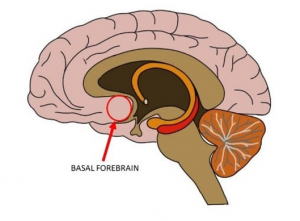
The basal forebrain acts as the on/off switch for the DMN. The basal forebrain directs sensory functioning and goal directed behavior and disconnects awareness of the external world by activating the DMN (Hayakrishan et al., 2018).
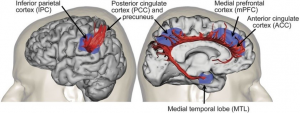
The DMN is now believed to be brain system that gives us a sense of our “core self” (Davey, Pujol, & Harrison, 2016; Gruberger et al., 2015). There appear to be three structures within the DMN system which are essential for the sense of self. These are the medial prefrontal cortex (MPFC), posterior cingulate cortex (PCC), and inferior parietal lobule. This tripartite system is the seat of self-referencing thought (Davey, Pujol, & Harrison, 2016).
It is a standard teaching point that massage therapy, if done correctly, activates the client’s peripheral nervous system which then puts him or her into a highly relaxed state. While this is undoubtedly true, it is not accurate—indeed, it is now an entirely obsolete belief—as the DMN controls relaxation and sleep-onset. While there have been very few studies of massage and neural activity there has been one study that has investigated the DMN activity during a brief massage application of Swedish style, reflexology, and use of a massage hand tool. This study applied these three techniques to the plantar side of the right foot of 42 subjects while their brains were being scans. Results showed that Swedish massage activated the anterior and posterior cingulate cortices (Sliz et al, 2012).
The neural health and integrity of the DMN are crucial for the experience of the embodied self. Any neural damage that degrades the connectivity of the DMN contributes to cognitive decline as well as other neurocognitive disorders. It now appears that cognitive deterioration can be slowed by practicing specific types of meditation and following a healthy lifestyle (Ramírez-Barrantes et al., 2016).
I’ll be writing more about these subjects in the future. Please be sure to visit the CBE occasionally to stay on top of the latest developments.
Paul Shane, Ph.D., LMT
Director, Academic Content
References
Buckner, R. & DiNicola, L. (2019). The brain’s default network: Updated anatomy, physiology and evolving insights. Nature Reviews: Neuroscience 10, p. 593-608.
Davey, C., Pujol, J., & Harrison, B. (2016). Mapping the self in the brain’s default mode network. NeuroImage 132, p. 390-397.
Hayakrishan, N., Klaasen, A., Arato, J., Vyssotski, A., Harvey, M., & Rainer, G. (2018). Basal forebrain contributes to default mode network regulation. PNAS 115(6), p. 1352-1357.
Raichle, M. (2010). Two views of brain function. Trends in Cognitive Sciences 14(4), p. 180–190.
Raichle, M. E., MacLeod, A. M., Snyder, A. Z., Powers, W. J., Gusnard, D. A., & Shulman, G. L. (2001). A default mode of brain function. Proceedings of the National Academy of Sciences of the United States of America, 98, 676–682.
Ramírez-Barrantes, R., Arancibia, M., Stojanova, J., Aspé-Sánchez, M., Córdova, C., & Henríquez-Ch, R. (2019). Default mode network, meditation, and age-associated brain changes: What can we learn from the impact of mental training on well-being as a psychotherapeutic approach? Neural Plasticity, doi.org/10.1155/2019/7067592.
Sliz, D., Smith, A., Wiebking, C., Northoff, G., & Hayley, S. (2012). Neural correlates of a single-session massage treatment. Brain Imaging and Behavior 6, p. 77-87.