
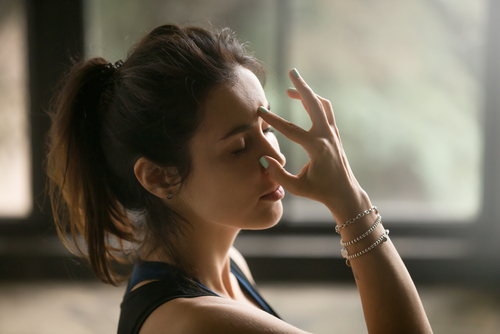
I’m a guy who does not just practice alternate nostril pranayama breathing when I’m in yoga class but does so in different settings… like when sitting trapped in bumper-to-bumper traffic, standing in the grocery line, and either before rising in the morning or before retiring for the night. It’s a great technique which never fails to relax and center me and one that does not take much effort to achieve a good result.
One long-standing belief in the practice of breathwork is that it induces relaxation while reducing stress. Brain studies show that neural pathways activated by patterned breathing are related to emotion regulation, cognition, focusing, perception, self-awareness, and decision making. Specific breathing patterns are beneficial in reducing stress, anxiety, insomnia, posttraumatic stress disorder, obsessive-compulsive disorder, depression, attention deficit disorder, and schizophrenia (Brown, Gerbarg, & Muench, 2013). And there are several techniques for accomplishing this including slow versus fast breathing and steady breath with long or short inhales, long or short exhales, or short time of holding the breath.
Breathing techniques are used in the meditative and the martial arts and can be applied for clinical problems: anxiety, depression, acute or chronic pain, cardiovascular diseases, and pulmonary diseases. Slow breathing is an integral part of many mind-body practices including yoga, tai chi ch’uan, qigong, and meditation techniques. A meta-analysis of 44 studies examining the effects of yogic alternate nostril breathing (anulom-vilom pranayama) conclude that there is a high level of evidence for improving cardiovascular, pulmonary, autonomic nervous system, and cognitive functioning (Ghiya, 2017).
Slow breathing is scientifically defined as less than ten breaths per minute. Breathing slowly reduces psychological stress as measured by subjective self-reporting. The lowering of psychological stress is attributed to slow breathing rhythms entraining neural activity in brain networks that control emotion, cognition, and memory. Slow breathing also lowers stress as seen in changes in the autonomic nervous system with a decrease in sympathetic and increase parasympathetic response.
Yogic breathing—sometimes known as abdominal or diaphragmatic breathing—affects cardiac rhythm and central nervous system functions. It is unclear yet how this happens, but there are several hypotheses.
Five Theories
Note: This blog-lecture examines just the technique of slow breathing as applied in the research study to be discussed next. It does not include the rapid breathing techniques known as “connected breathing” or “Bellow’s Breath” such as Holotropic Breathwork (Miller & Nielsen, 2015; Rhinewine & Williams, 2007) or Rebirthing (Albery, 1984, 1985; Moden, 1992).
- A meta-analysis focusing on cardio-respiratory and central nervous system found 2,461 articles of which only 15 articles met review criteria for selection. Slow breathing techniques initiate autonomic changes affecting the cardiovascular system. EEG studies showed an increase in alpha wave activity. Anatomically, the only available fMRI study highlights increased activity in both brain structures such as the prefrontal cortex, motor cortex, and parietal lobes as well as subcortical regions such as the pons, thalamus, sub-parabrachial nucleus, periaqueductal gray, and hypothalamus. The conscious experiential state related to these brain changes are increased comfort, relaxation, pleasantness, vigor and alertness, and reduced symptoms of arousal, anxiety, depression, anger, and confusion.
Two possible explanations are offered for these effects. The first is based on the conscious regulation of internal bodily states via the vagus nerve and the nucleus of the Tractus Solitarius while the other centers on mechanoreceptor activity in the nasal vault which modulates activity of the olfactory bulb and then the activity of the entire cortex (Zaccaro et al., 2018).
- Jerath et al. (2018) hypothesized the involvement of the lungs’ stretch receptors and of stretching pulmonary connective tissue which neural signals for the slow adaptation of stretch receptors to “reset” the autonomic nervous system (Matsumoto et al., 2000; Kamkin et al., 2005).
- Gard et al., (2014) hypothesize that yoga may involve top-down brain processing involving attention, working memory, and executive monitoring. There are three brain networks associated with these functions. The default mode network which puts the brain-body in a resting state and gives a person a core sense of self and based in the posterior parietal cortex and the ventromedial prefrontal cortex. The next is the central executive network responsible for cognitive processing of complex information and comprised of the dorsolateral prefrontal and the posterior parietal cortex and the fronto-parietal network including the dorsolateral prefrontal and the anterior cingulate cortices, the inferior frontal junction, the pre-supplementary motor area, and the intraparietal sulcus.
- Taylor et al. (2010) suggested the existence of an executive homeostatic network which governs the cardiovascular and immune systems, and which may play an integral part in the healing responses of the body. This network includes the anterior cingulate, the prefrontal and the insular cortices, areas involved in physiological self-awareness and cognitive modulation. This hypothesis is partially supported by Critchley et al. (2015) and Yu et al. (2011) who found activation of the anterior prefrontal, motor, supplementary motor and parietal cortices using EEG monitoring during Zen slow breathing techniques.
- One last theory proposes a purely neurophysiological framework based on thalamic and cortical activities stimulated by the olfactory bulb. The neural activity of this structure is stimulated by the rushing of air passing over the olfactory epithelium during nostril breathing (Fontanini & Bower, 2006) given that most slow breathing techniques are performed via nasal inhalation (Jerath et al., 2006). Studies on specific Pranayama techniques indicate that nasal breathing can modulate both the autonomic system and brain activity through receptors located in the superior nasal meatus which are sensitive both to mechanical and chemical stimuli (Wrobel & Leopold, 2005; Kepecs, Uchida, & Mainen, 2006)
An Intriguing Study by Birdee (2023)
A new research study into the effects of slow breathing and variations in the ratio of short or long inhalation versus short or long exhalation. Birdee et al., (2023) conducted a 12-week random control trial of 100 test subjects using Yogic breathing. They specifically wanted to know if there were measurable differences in test subjects exhaling longer than their intake versus a breath cycle of equal time of inhalation-exhalation.
Subjects met privately with a certified Yoga instructor for 12 weekly sessions. Each session was 45 minutes in duration. Subjects also practiced their breathing at home using printed instructions. This went on for two weeks at which time the Yoga teacher assessed each subject’s respiratory rate. Those who could breathe at eight breaths per minute were selected to join the study. This breathing rate was from traditional Yoga practice which believes that breathing faster than eight breaths per minute is ineffective. Those subjects who could breathe even slower—at three breaths per minute—also were not selected for the study. The study commenced by first randomizing the subjects into two experimental variable groups.
- Slow breathing with exhale equals inhale (E = I).
Participants randomized to slow breathing with equal inspiration and expiration received progressive increases in both inspiration and expiration over 10 weeks until they reached a goal breath length or longest comfortable breath. Prior to performing the breathing practice, participants performed a few brief standardized yoga movements. Yoga movements are an ancient bodymind balancing system incorporating slow breathing and often regulated breathing with longer exhalation or longer inhalation.
- Slow breathing with exhale longer than inhale (E > I).
Participants randomized to slow breathing with prolonged exhale to inhale ratio received progressive increases in expiration relative to inspiration over 10 weeks until they reached a goal breath length or longest comfortable breath. Prior to performing the breathing practice, participants performed the same yoga movements as the E=I group. The slow breathing practices result in improved psychological and physiological measurements, but the altered ratio of breathing in and out made no measurable difference.
Closing Thoughts

There are many different breathing patterns. I was a brief devotee to Sudarshan Kriya breathing (Brown & Gerbarg, 2005) with Transcendental Meditation back in the mid-1990s and then practiced Holotropic Breathwork in the early 2000s. I still do Bellow’s Breath (deep, rapid circular abdominal breathing) for a few cycles when feeling fatigued or not quite awake. There are different techniques that use arm movements or whole-body movements as found in Arica (integrated breath), karate (stretching for chest expansion), qigong, and walking breath meditation. Qigong alone has dozens of variations, but my personal favorite is Ba Duan Jin or, as it is also known, The Eight Silk Brocade (Pike, 1996). It is currently estimated that about 12 percent of the adult population in the United States uses some form of breathing technique for health improvement (Barnes, Bloom, & Nahin, 2008).
Breathing is one of those practices that is both powerful and life-affirming and slow abdominal breath—a Yoga standard—can be done just about anytime and anywhere. This article underscores the ease and simplicity of slow breathing for relaxation and health benefits. It is also of particular significance because it empirically shows altering the ratio of inhale vs. exhale doesn’t seem to really matter. I’m sure many yoga instructors will be distressed by this finding.
Paul Shane, Ph.D., LMT
Director, Academic Content
References
Albery, N. (1984). Leonard Orr’s Rebirthing. Self & Society 12(5), p. 264-274.
—– (1985). Rebirthing: The Primal Context. Self & Society 13(1), p. 14-29.
Barnes, P., Bloom, B., & Nahin, R. (2008). Complementary and alternative medicine use among adults and children: United States 2007. Washington DC: National Health Statistical Report 12, p. 1–23.
Birdee, G., Nelson, K., Wallston, K., Nian, H., Diedrich, A., Paranjape, S., Abraham, R., & Gamboa, A. (2023). Slow breathing for reducing stress: The effect of extending exhale. Complementary Therapies in Medicine 73, 102937, https://doi.org/10.1016/j.ctim.2023.102937.
Brown, R. & Gerbarg, P. (2005). Sudarshan Kriya yogic breathing in the treatment of stress, anxiety, and depression. Part II – clinical applications and guidelines. Journal of Alternative & Complementary Medicine 11(4), p. 711-717.
Brown, R. Gerbarg, P., & Muench, F. (2013). Breathing practices for treatment of psychiatric and stress-related medical conditions. Psychiatric Clinics of North America 36, p. 121-140.
Critchley, H., Melmed, R., Featherstone. E., Mathias, C., & Dolan, R. (2002). Volitional control of autonomic arousal: a functional magnetic resonance study. Neuroimage 16(4), p. 909–919.
Fontanini, A. & Bower, J. (2006). Slow-waves in the olfactory system: An olfactory perspective on cortical rhythms. Trends in Neuroscience 29(8), p. 429-437.
Gard, T., Noggle, J., Park, C., Vago, D., & Wilson, A. (2014). Potential self-regulatory mechanisms of yoga for psychological health. Frontiers in Human Neuroscience 8, 770, doi: 10,3389/fnhum.2014.00770.
Ghiya, S. (2017). Alternate nostril breathing: A systematic review of clinical trials. International Journal of Research in Medical Sciences 5(8), p. 3273-3286.
Goulden, N., Hkusnulina, A., Davis, N., Bracewell, R., Bokde, A., McNulty, J., & Mullins, P. (2014). The salience network is responsible for switching between the default mode network and the central executive network – Replication from DCM. NeuroImage 99, p. 190-190.
Jerath, R., Edry, J., Barnes, V., & Jerath, V. (2006). Physiology of long pranayamic breathing: Neural respiratory elements may provide a mechanism that explains how slow deep breathing shifts the autonomic nervous system. Medical Hypotheses 67(3), p. 566-672.
Kamkin, A., Kiselva, I., Lozinsky, I., & Scholz, H. (2005). Electrical interaction of mechanosensitive fibroblasts and myocytes in the heart. Basic Research in Cardiology 100(4), p. 337–345.
Kepecs, A., Uchida, N., & Mainen, Z. (2006). The sniff as a unit of olfactory processing. Chemical Senses 31(2), p. 167-170.
Matsumoto, S., Ikeda, M., Nishikawa, T., Tanimoto, T., Yoshida, S., & Saiki, C. (2000). Inhibitory mechanism of slowly adapting pulmonary stretch receptors after release from hyperinflation in anesthetized rabbits. Life Science 67(12), p. 1423–1433.
Miller, T. & Nielsen, L. (2015). Measure of significance of holotropic breathwork in the development of self-awareness. The Journal of Alternative and Complementary Medicine 21(12), p. 796-803.
Moden, G. (1992). The Rebirthing process. Self & Society 20(2), p. 7-9.
Pike, G. (1996). Chi: The Power Within. North Clarendon, VT: Tuttle Publishing.
Rhinewine, J. & Williams, O. (2007). Holotropic Breathwork: The potential role of a prolonged, voluntary hyperventilation procedure as an adjunct to psychotherapy. The Journal of Alternative and Complementary Medicine 13(7), p. 771-776.
Vanderwal, T., Eilbott, J., & Castellanos, X. (2019). Movies in the magnet: Naturalistic paradigms in developmental functional neuroimaging. Developmental Cognitive Neuroscience 36, 100600, https://doi.org/10.1016/j.dcn.2018.10.004.
Wrobel, B. & Leopold, D. (2005). Olfactory and sensory attributes of the nose. Otolaryngological Clinics of North America 38(6), p. 1163-1170.
Yu, X., Fumoto, M., Nakatani, Y., Sekiyama, T., Kikuchi, H., Seki, Y., Sato-Suzuki, I., & Arita, H. (2011). Activation of the anterior prefrontal cortex and serotonergic system is associated with improvements in mood and EEG changes induced by Zen meditation practice in novices. International Journal of Psychophysiology 80(2), p. 103-111.
Zaccaro, A., Piarulli, A., Laurino, M., Garbella, E., Menicucci, D., Neri, B., & Gemignari, A. (2018). How breath-control can change your life: A systematic review on psycho-physiological correlates of slow breathing. Frontiers in Human Neuroscience 12, article 353, doi: 10.3389/fnhum.2018.00353.