
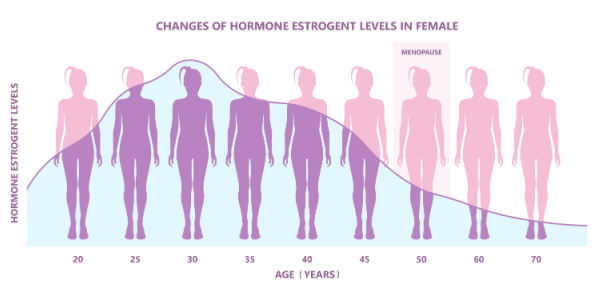
The final somatic milestone in the developmental path of women is menopause. Menopause is the cessation of menses and childbearing capacity from the loss of ovarian follicular activity. It occurs with the onset of middle age—sometime between 40 and 65 years—but typically by the time when a woman enters her 50s (Vincent et al., 2023). Menopause is marked by disturbing physical sensations and changes in physiological processes. It is certain that these physical changes are disturbing and most likely affect body image. There are several categories of change:
- physical changes (twitchy legs, weight gain, skin wrinkling, vaginal thinning, hair loss);
- body alienation (anxiety, confusion, shock, embarrassment, shame);
- somatic (vaginal dryness, itchy vulva, insomnia, somatized pains, headaches, lower energy levels, bladder problems, transient numbness, body temperature fluctuations);
- psychological problems (lower libido, depression, mood changes, poor concentration, memory changes) (Deeks & McCabe, 2001; Stephens, 2001; Vincent et al., 2023).
While both the male and female body change over time, a woman’s body is subject to more variations than a man’s. Menarche, monthly cycles, weight gain, pregnancy, breast feeding, deterioration of physical appearance, and menopause are all major events in woman’s life cycle as compared to the male life cycle of spermarche, muscle gain, weight gain and muscle loss, deterioration of physical appearance, hair loss, and andropause. Women are also more impacted by body change because of the idolization of youth and thinness here in the West. Women grow up under the “tyranny of slenderness” (Chernin, 1981). Men just need to be of average weight with good muscle tone to get by. Neither body image journey is easy, but women seem to weather more storms. And both sexes are condemned to chronic unhappiness with their body images, but again, women bear the greater somatopsychic burden of greater shame and distress (Krekula, 2016). This is especially so given the pressures of age discrimination and the “double standard” of beauty between women and men.
Menopause occurs at approximately the same time when people reflect on their lives and compare their accomplishments and situation with their expectations or a renewed sense of meaning and purpose. This latter activity, I think, occurs within the framework of re-evaluating one’s body-self relationship. A recent research study delved more deeply into the transformation of women’s body image over time. It conducted retrospective surveys of 102 women over 65 at 15 senior communities and centers in the American Midwest in 2012 who were asked about their past and current body image perceptions. It found that women’s visions of their ideal body shape changed less over time than their actual body shape (body schema). This means that the experiential gap between the ideal and the actual continues to increase along with body dissatisfaction and disturbed body image. As the experiential gap between the actual and ideal body shape widens over time, women became increasingly dissatisfied with their bodies (Lee & Damhorst, 2020). That is, they experience more body image distress although is subject to variation depending on the woman’s personality, attitude, and surrounding environment.
Menopause creates tension between a woman’s personal and social expectations. Personal expectations refer to maintaining the integrity of body-self and meeting body image ideals. Social expectations regard the continuance of sexuality, social rejection by a youth-oriented culture, and adapting to the “empty nest syndrome” (Stotland, 2002).
Time, though, I think is the real problem.
One thing that fights against time and its uncontrollable changes is the heightened sense of the body being an experiential body—the body one feels as one’s own in the present moment IS reality. This is why the somatic reality of so many older adults feels entirely different from their chronological age. Women become sensitized to the inner self versus the outer self and think of the body as being nothing more than a shell, casing, container, or vehicle for holding the true self. There is also a growing awareness of feeling trapped within one’s body. Another experience that appears is that of the experiential body continuing through time while the actual physical body is subject to ongoing problems and deterioration (Clarke, 2001).
The experiential body is the “ageless self” as it has been once called (Kaufman, 1986). And that ageless self is NOT the body image, but the body schema; the actual experience of embodiment. Which means that body awareness can help a woman navigate the troubling changes of menopause. Other factors that support a woman in her body image transition found in an Iranian study is her education, career status, socioeconomic level, and home ownership. There are other important factors to help support the aging body image of females including spirituality, exercise, body sanctification, gratitude and appreciation. These are positively correlated with healthy body image (Nazarpour et al., 2021; Shane, 2023).
Closing Thoughts
As I have discussed elsewhere, there are three great paradoxes of embodied consciousness (Shane, 2023). The first is that we are and we are not our bodies. The second is that I own a body, but my body also owns me. Then, there is notion that our bodies are both subjects and objects. This little study of menopause illustrates the reality of the first and second paradoxes. These paradoxes allow a person to place their body in a new perspective for coping with the trials of old age. The key here is learning to psychologically and spiritually transcend the body by focusing on the experiential body rather than the physical body; i.e., concentrate on the body schema rather than get hung up on the body image. This is a radical challenge in the body-mind relationship and may be the final development task to be resolved just prior to death. It is the concept of Gerotranscendence which is covered in another blog-lecture. Also, if this topic is of interest, I recommend you review my blog-lectures on the Journey of the Feminine Bodymind, 16 Signs of Gerotranscendence, and Embodied Consciousness at 85.
Paul Shane, Ph.D., LMT
Director, Academic Content
References
Chernin, K. (1981). The Obsession: Reflections on the Tyranny of Slenderness. New York, NY: Harper.
Deeks, A. & McCabe, M. (2001). Menopausal stage and age and perceptions of body image. Psychology and Health 16, p. 367-379.
Clarke, L. (2001). Older women’s bodies and the self: The construction of identity in later life. Canadian Sociology & Anthropology 38(4), p. 441-464.
Kaufman, S. (1986). The Ageless Self: Sources of Meaning in Late Life. Madison, WI: University of Wisconsin Press.
Krekula, C. (2016). Contextualizing older women’s body images: Time dimensions, multiple reference groups, and age codings of appearance Journal of Women & Aging 28(1), p. 58-67
Lee, M. & Damhorst, M. (2020). Women’s body image throughout the adult life span: A latent growth modeling approach. The International Journal of Aging and Human Development 9(3), p. 317-339.
Nazarpour, S., Simar, M., Majd, H., Torkamani, Z., Andarvar, K., & Rahnemaei, F. (2021). The relationship between postmeonopausal women’s body image and the severity of menopausal symptoms. BMC Public Health 21, https://doi.org/10.1186/s12889-021-11643-6
Pearce, G., Thøgersen-Ntoumani, C., & Duda, J. (2014). Body image during menopausal transition: A systematic scoping review. Health Psychology Review 8(4), p. 473-489.
Shane, P. (2023). Principles of Somatic Psychology: An Evidence-Based, Transdisciplinary Approach for the Holistic Health Professions. Brecksville, OH: Center for Bodymind Education.
Stephens, C. (2001). Women’s experience at the time of menopause: Accounting for biological, cultural and psychological embodiment. Journal of Health Psychology 6(6), p. 651-663.
Stotland, N. (2002). Menopause: Social expectations, women’s realities. Archives of Women’s Mental Health 5, p. 5-8.
Vincent, C., Bodnaruc, A., Prud’homme, D., Olson, V., & Giroux, I. (2023). Associations between menopause and body image: A systematic review. Women’s Health 19, p. 1-20.