
Geometry, Mysticism, and Somatic Idealism
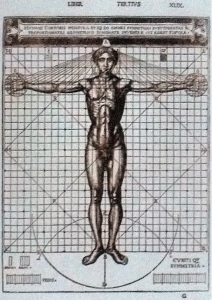 Marcus Vitruvius Pollio (c. 80-15 BC) was a Roman architect and engineer made famous by his massive, De Architectura, a treatise on architecture. He theorized that good building structure should have strength, utility, and beauty. He also observed that the proportions of the human body possessed geometric harmony and beauty. The work was then lost for centuries and rediscovered in a Swiss monastery library in 1414 by Poggio Bracciolini (1380-1459), a noted humanist from Florence. Bracciolini was inspired by both the physical and metaphysical implications of Pollio’s ideas and wrote, “All the arts and all the world’s rules are derived from a well-composed and proportioned human body… Man, called a little world, contains in himself all the general perfections of the whole world” (quoted in Isaacson, 2017, p. 149). Vitruvius designed a Roman temple using the analogy of the proportions of the human body to signify both the sacred space and the sacredness of its model. Symmetry here is the key aesthetic standard for what constitutes the beautiful.
Pollio’s ideas were then adapted by Leonardo Da Vinci in 1489. He re-measured the human body to double-check Pollio’s original ratios and found some errors. These studies resulted in Da Vinci’s own version of the Vitruvian Man.
 Leonard’s own Vitruvian Man embodies a moment when art and science combined to allow mortal minds to probe timeless questions about who we are and how we fit into the grand order of the universe. It also symbolizes an ideal of humanism that celebrates the dignity, value, and rational agency of humans as individuals. Inside the square and the circle we can see the essence of Leonardo da Vinci, and the essence of ourselves, standing naked at the intersection of the earthly and the cosmic (Isaacson, 2017, p. 157).
The underlying idea here is that the human body is a reflection of the Cosmos. Pollio knew this and even remarked that the idea was an ancient one. The principle is known as “As above, so below” meaning the that the structures and movements of the heavens are mirrored in the human body.
The Beauty of Symmetry
This desire for symmetry is an ancient one and very much alive today as verified by the numerous studies of physical attraction. Contemporary science reveals four essential aspects that make a person attractive: facial symmetry, high averageness of facial shape, sexually dimorphic features, and skin quality.
Facial symmetry is a powerful stimulant for attracting the attention of others (Grammer & Thornhill, 1994; Jones et al., 2001; Perrett et al., 1999; Rhodes et al., 1999, 2000, 2001). Averageness of shape is also a powerful mechanism that positively influence judgments of the attractiveness of male and female faces (Grammer & Thornhill 1994; Little & Hancock 2002; Perrett et al., 1994; Rhodes et al., 1999, 2001).
Then there is the quality of sexual dimorphism or the degree of masculinity or femininity of the face. Female faces with a feminine shape exemplified by large eyes and prominent cheekbones are judged highly attractive (Penton-Voak et al., 2001; Perrett et al., 1998; Rhodes et al., 2000). Studies have found that male faces with a masculine shape, typified by a wide lower face and pronounced brow are judged highly attractive (Johnston et al., 2001; Penton-Voak et al., 2001). Other studies suggest that male faces with a slightly feminine shape are preferred by some women (Little & Hancock, 2002; Perrett et al 1998; Rhodes et al 2000). Women also prefer highly feminine faces when looking at other women (Little et al., 2008). Some women have no preferences either way (Scheyd, Garver-Apgar, & Gangestad, 2008; see also Harris, 2013). The degree of masculinity women desire in male faces varies and is further complicated by their menstrual cycles. Women, particularly those in mid-menstrual cycle, prefer a man with a symmetric, masculine face especially when pursuing short-term sexual encounters (Fisher & Cox, 2009; Gangestad, Thornhill, & Garver-Apgar, 2010; Jones et al., 2008; Little et al., 2007, 2008, 2011; Little, Jones, & DeBruine, 2008; Welling, Jones, & DeBruine, 2008). Gay men prefer extremely masculine faces more so than heterosexual women while lesbians prefer masculine-looking female faces (Glassenberg et al., 2010).
Lastly, there is skin quality. Healthy skin is a primary visual signal (Jones et al., 2016) and natural attractant (Jones et al., 2004). Health in general is cue for sexual attractiveness especially regarding the appearance of the body (Brierley et al., 2016).
Each factor by itself exerts enormous power but, overall, symmetry and averageness reign supreme. These are the modern representatives of balance and harmony.
Beauty is not in the eye of the beholder unless there is symmetry. People whose faces are asymmetrical are not aesthetically pleasing nor do they excite the passions.
The Harmony of the Body and the Spirit
The Vitruvian Man is a body ideal in that his proportions represent an optimal balance and harmony. One might say that the Vitruvian Man was the first ideal body type and has led the way for others that have followed. Jean-Jacques Rouseau’s (1712-1788) “Natural Man” who is untouched by the evils of society and free in both body and mind. This body ideal was the predecessor to Wilhelm Reich’s “Genital Character” who was freed from psycho-muscular armoring. Another example is that of Dr. Ida Rolf’s perfectly balanced body which, as a consequence of its fascial freedom and alignment in the gravity field, is also psychologically balanced. Likewise, the ideal body of yoga practice enjoys a free range of motion, strength, and deep breath capacity also enjoys emotional and spiritual freedom. The goal of yoga is the union of body and mind. Psychological balance and body awareness follow these physical changes. These models are all admirable and worthy of study and practice, but like all idols, they have feet of clay for if taken too far they become sources of personal and psychological stress and shame.
Closing Thoughts
The common theme to all of these is balance and harmony.
The Vitruvian Man symbolizes many things. Humans are a reflection of the Cosmos, both in their body form and internal structures. Humans are a reflection of the Godhead. We are born virtuous in that our structure reflects the Good and the Beautiful in the Platonic sense. The balanced physique is the template for well-balanced are, architecture, and the good life. The good life is marked by balance and harmony; internal and external. And, because we are a reflection of the Cosmos we can, through various means, transcend ourselves and become greater than we are. The Vitruvian man is the symbol of human spirituality—rooted in the body-soul—and our place in the greater spirit of the Universe.
Paul Shane, Ph.D., LMT
Director, Academic Content
References
Brierley, M., Brooks, K., Mond, J., Stevenson, R., & Stephen, I. (2016). The body and the beautiful: Health, attractiveness and body composition in men’s and women’s body. PLOS ONE, DOI:10.1371/journal.pone.0156722.
Fisher, M. & Cox, A. (2009). The influence of male facial attractiveness on women’s receptivity. The Journal of Social, Evolutionary, and Cultural Psychology 3(1), p. 49-61.
Gangestad, S., Thornhill, R., & Garver-Apgar, C. (2010). Fertility in the cycle predicts women’s interest in sexual opportunism. Evolution and Human Behavior 31(6), p. 400-411.
Grammer K. & Thornhill, R. (1994). Human (Homo sapiens) facial attractiveness and sexual selection: The role of symmetry and averageness. Journal of Comparative Psychology 108, p. 233-242.
Harris, C. (2013). Shifts in masculinity preferences across the menstrual cycle: Still not there. Sex Roles 69, p. 507-515.
Isaacson, W. (2017). Leonardo Da Vinci. New York, NY: Simon & Schuster.
Johnston. V., Hagel, R., Franklin, M., Fink, B., & Grammer, K. (2001). Male facial attractiveness: Evidence for a hormone-mediated adaptive design. Evolution and Human Behavior 22, p. 251-267.
Jones, B., Little, A., Burt, D., & Perrett, D. (2004). When facial attractiveness is only skin deep. Perception 33, p. 569-576.
Jones, B., Little, A., Penton-Voak, I., Tiddeman, B., Burt, D., & Perrett, D. (2001). Facial symmetry and judgements of apparent health: Support for a `good genes’ explanation of the attractiveness-symmetry relationship. Evolution and Human Behavior 22, p. 417-429.
Jones, B., Porcheron, A., Sweda, J., Morizot, F., & Russell, R. (2016). Coloration in different areas of facial skin is a cue to health: The role of cheek redness and periorbital luminance in health perception. Body Image 17, p. 57-66.
Little, A. & Hancock, P. (2002). The role of masculinity and distinctiveness in judgements of human male facial attractiveness. British Journal of Psychology 93, p. 451-464.
Little, A., Jones, B., Burt, D., & Perrett, D. (2007). Preferences for symmetry in faces change across the menstrual cycle. Biological Psychology 76, p. 209-216.
Little, A., Jones, B., & DeBruine, L. (2008). Preferences for variation in masculinity in real male faces change across the menstrual cycle: Women prefer more masculine faces when they are more fertile. Personality and Individual Differences 45, p. 478-482.
——————————————— (2011). Facial attractiveness: Evolutionary based research. Philosophical Transactions of the Royal Society 366, p. 1638-1659.
Penton-Voak, I., Jones, B., Little, A., Baker, S., Tiddeman, B., Burt, D., & Perrett, D. (2001). Symmetry, sexual dimorphism in facial proportions and male sexual attractiveness. Proceedings of the Royal Society of London, Series B 268, p. 1617-1623.
Penton-Voak, I. & Perrett, D. (2001). Male facial attractiveness: perceived personality and shifting female preferences for male traits across the menstrual cycle. Advances in the Study of Behavior 30, p. 219-260.
Perrett, D., Burt, D., Penton-Voak, I., Lee, K., Rowland, D., & Edwards, R. (1999). Symmetry and human facial attractiveness. Evolution and Human Behavior 20, p. 295-307.
Rhodes, G., Hickford, C., & Jeffrey, L. (2000). Sex-typicality and attractiveness: Are supermale and superfemale faces super-attractive? British Journal of Psychology 91, p. 125-140.
Rhodes, G., Sumich, A., & Byatt, G. (1999). Are average facial configurations attractive only because of their symmetry? Psychological Science 10, p. 52-58.
Rhodes, G., Yoshikawa, S., Clark, A., Lee, K., McKay, R., & Akamatsu, S. (2001). Attractiveness of facial averageness and symmetry in non-Western cultures: In search of biologically based standards of beauty. Perception 30, p. 611-625.
Scheyd, G., Garver-Apgar, C., & Gangestad, S. (2008). Physical attractiveness: Signals of phenotypic quality and beyond. In C. Crawford & D. Krebs (Eds.), Foundations of Evolutionary Psychology, New York, NY: Lawrence Erlbaum Associates, pp. 239-259.
Welling, L., Jones, B., & DeBruine, L. (2008). Sex drive is positively associated with women’s preferences for sexual dimorphism in men’s and women’s faces. Personality and Individual Differences 44, p. 161-170.
Revised on 10-24-24.