
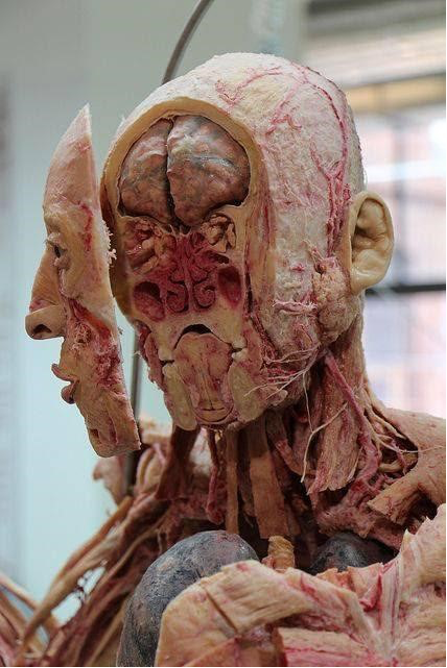
The Body in the Mind
German experimental sensory physiologists of the nineteenth-century were the first to investigate the nature of body sensations. They called general feelings of the body Gemeingefühl or “common sensation” and distinguished these from the five special senses. The neural area that appears to create this Gemeingefühl is the dorsal insular cortex. It contains a sensory model based on small diameter neural flow that gives the physiological status of the entire body. This area gives the awareness of temperature, pain, itch, muscular and visceral sensations, sensual touch and other feelings (Craig 2009).
William James (1890) observed that one’s body is a qualitatively different type of thing than all other physical objects. An object exterior to one’s body can be perceived and examined from a variety of angles or put outside of direct perception, but not so with one’s body. The experience of our bodies is immediate, personal, constant and, while the nuances of somatic experience are constantly changing, there always remains an overall sense of sameness; a continuous sense of unchanging stability. James called it “the feeling of the same old body always there.” Everyone’s body is always there, James said. More, he called it the “cornerstone of mental life” and the “storm-center” of experience (James, 1905). Defined by Longo, et al. (2008) as “A non-conceptual, somatic form of knowledge, different in kind from other types of knowledge… (p. 979). It is often considered the starting point of personal psychological identity (Cassam, 1997; Edelman, 2004).
Embodiment is hard to define. It’s easy to experience—barring neurological damage—but the experience is difficult to put into words. Embodiment is based on body sensations of variable acuity that give rise to the immediate knowledge that these body feelings are fundamentally tied to being alive. At higher levels of consideration, these feelings relate to homeostatic functioning that supports survival, mood stability, thought processes, and a sense of well-being. Perception of these internal bodily feelings are termed “interoception.” Interoception is composed of two distinct feeling-states: proprioception of feelings from the skin and muscles and visceroception of feelings from the inner organs.
Interoceptive acuity (IA) is a trait-like sensitivity to one’s own internal body sensations. This sensitivity appears to have an individual baseline of acuity which can be manipulated by experimental intervention or training in focusing on internal sensations. The sensitivity of IA varies by individual with some being more sensitive than others. This finding of variability of body awareness sensitivity comes from past studies of cardiovascular, gastrointestinal, and pain awareness. Sensations arise from the body’s interior and in our experience, we feel them as if they were located in that region, but the reality is that there is an “interoceptive neural network” in the brain composed of sensory and motor cortices, insula, anterior cingulate cortex, and prefrontal cortices formed by the ventromedial prefrontal cortex and the dorsolateral prefrontal cortex. This network processes, monitors, and responds to visceral information and emotions. It regulated emotional and behavioral responses. There is strong and growing evidence that IA is crucial for the intensity of emotional experience and the higher cortical processing of emotions (Herbert & Pollatos, 2012). IA also underlies our perception of time. The awareness of ever-changing physiological states and emotional responses changes our perception of time (Craig, 2009). One experimental investigation has shown that the encoding of time intervals occurs within the bilateral posterior insula and the superior temporal cortex (Wittmann, Simmons, Aron, & Paulus, 2010).
The neural system of IA is literally “the body in the mind” (Herbert & Pollatos, 2012). This is an important image to consider.
The Brain in the Body
The anterior insular cortex (AIC) is responsible for a wide range of bodily experiences and influences higher cognitive functioning such as decision making and spontaneous intuitive insights. The evidence strongly indicates that the AIC is the neural correlate of body consciousness. The AIC is activated by visceral activities such as pain, thirst, shortness of breath, air hunger, the Valsalva maneuver, itch, coolness, warmth, exercise, heartbeat, wine-tasting, and distension of the bladder, rectum, and esophagus (Craig, 2002, 2009).
The AIC influences emotional response as it is responsible for empathic sensations including romantic and maternal love, anger, fear, disgust, aversion, happiness, unfairness, inequity, indignation, uncertainty, disbelief, trust, social exclusion, sculptural beauty, and the experience of God. More interestingly, the AIC allows sexual experience as it gives us the experiences of sensual touch, genital stimulation, sexual arousal, and orgasm. This makes perfect sense because in most studies, the AIC activates with the anterior cingulate cortex (ACC). These two brain centers have a complementary relationship with the limbic sensory and motor systems. The processing of emotional experience and its influence on cognition appears to be controlled by a small network of brain areas including AIC, ACC, amygdala, and hypothalamus (Craig, 2002, 2009).
In terms of body awareness, the AIC is related to the experience of body control and movement. Craig (2009) proposes that the AIC contains a somatotopic map representing subjective body movements. Besides Craig’s work, there are a handful of self-recognition studies showing the AIC and ACC activates when test subjects are shown photographs of themselves. This suggests that the abstract concept of self may arise from these areas giving each of us the sense of an on-going self.
The flow of neural experience from the rear to the front of the AIC creates all subjective body feelings and emotions in the immediate moment and through memory makes them accessible for present-past state comparison over time as well. The flow of human awareness is based on homeostasis because time flows continuously at a standard rate, but the fluctuating experiences of emotional and physical sensations create the subjective state of time compared to constant homeostatic flow (Craig, 2009).
Craig’s Model of Body Awareness
 This model of body consciousness is a continuous flow of individual moments of experience. The key to having a seamless experience of body-self is the integration of each moment of experience by its salience and its salience is determined by its survival value for the organism and species (see graphic). The final outcome of this neural processing by the AIC is the “unified final meta-representation of the ‘global emotional moment’ near the junction of the anterior insula and the frontal operculum” (Craig, 2009, p. 67). This finding is in line with Antonio Damasio’s “somatic marker” hypothesis that asserts that the foundation of our emotional life are the fluctuating physiological states of the body (Damasio, 2000).
Closing Thoughts
Body awareness in general appears to be a function of the coordinated and integrated activities of several cortical areas including the posterior parietal cortex, insula, and the primary and secondary somatosensory cortices. Each area serves a different yet crucial purpose and, when neurally blended together, we experience the thing we call “my body.” We use terms like “olfactory,” “vestibular,” and “vasomotor” in referring to various types of consciousness of various types of bodily functioning, but these do not convey in any real sense of the actual experience of these body consciousness(es).
Body consciousness is the ultimate paradox because it exists as a second-by-second construction of multiple pieces and the whole is incredibly fragile and fleeting like an open flame. Second, while it is true that the body, as with all of physical reality, is a solid object, given that all experience is a neural representation in the brain, then on a philosophical level at least, reality and our bodies are illusions. Lastly, because of the nature of neural transduction, all of this means is that your body is inside of your brain and your brain is inside of your body. Each of us from a neurophilosophical perspective is a living paradox.
Paul Shane, Ph.D., LMT
Director, Academic Content
References
Cassam, Q. (1997). Self and World. Oxford: Oxford University Press.
Craig, A. (2002). How do you feel? Interoception: the sense of the physiological condition of the body. Nature Reviews Neuroscience 3, p. 655-666.
Craig, A. (2009). How do you feel—now? The anterior insula and human awareness. Nature Reviews Neuroscience 10, p. 59-70.
Damasio, A. (2000). The Feeling of What Happens: Body, Emotion and the Making of Consciousness. London, UK: Heinemann.
Edelman, G. (2004). Wider Than the Sky: The Phenomenal Gift of Consciousness. New Haven, CT: Yale University Press.
Herbert, B. & Pollatos, O. (2012). The body in the mind: On the relationship between interoception and embodiment. Topics in Cognitive Psychology 4(4), p. 692-704.
James, W. (1890). The Principles of Psychology, Vols. 1 & 2. New York, NY: Henry Holt & Co.
Longo, M., Schüür, F., Kammers, M., Tsakiris, M., and Haggard, P. (2008). What is embodiment? A psychometric approach. Cognition 107, p. 978-998.
Wittmann, M., Simmons, A., Aron, J., & Paulus, M. (2010). Accumulation of neural activity in the posterior insula codes the passage of time. Neuropsychologia 48(10), p. 110-120.